Translate

Student-Led Physio Service

Tuesday, June 18, 2019

RockPods in the Student-Led Physio Service


 What are Rock pods?

Rock Pods are a version of cupping.  They are medical grade silicone cups that come in 2 sizes.  Each set of Pods has 4 large an 4 small cups and come in a convenient carry case.


What are they designed to do?

Cupping creates a decompressive force in the tissues immediately under the cup (with a compressive force created around the rim of the cup).  This lifting of the tissues can be a different stimulus to the tissues and the nervous system and for some people can be a relaxing way of treating tight or sore areas.  The decompressive effect is greater than that generated by RockTape but the two modalities are essentially treating the same way.  It is the opposite of many other forms of manual therapy that typically create a compressive force such as massage, use of massage tools, floss bands and compression bandages.

What’s the different between these and the glass ones?

Traditionally, cupping was done with glass cups.  These are heated over a flame and then quickly applied to the body part to create the suction effect.  More recently, cupping sets have become plastic cups with a one-way valve at the top of the cup, with a hand operated vacuum pump generating the suction pressure.  The reliance on the vacuum pump can be problematic in a clinic with multiple treatment rooms when trying to locate the pump!  

The Rock Pods utilise an “in-built” suction system- you can use the plunger on the top of the Pod to press down and generate a moderate level of suction, or the cup can be inverted on itself, placed over the target tissue and the edges of the cup “rolled” into contact with the skin- this creates a significantly higher level of suction.  These two levels of suction allow the user to progress from a lighter suction force to a greater suction force if necessitated, but allows a lighter level of suction to be tried first.  This is in keeping with our philosophy “less is more”- start with “less”, and only progress to “more” if required.

The silicone pods are also easier to travel with as they are not breakable, eliminate the need to carry the vacuum pump and come with a much more compact carrying case.

Do they slide or move after applying?

These cups do not slide well on the skin once they are applied.  However they are excellent at maintaining suction pressure whilst the client moves with the Pods in place.

How long do you keep them on for?

Typically most Pods will be in place for only a few minutes at a time.  The lower body areas (low back and legs) are typically able to withstand longer application times, whereas the upper body (trunk, neck and arms) may get an adequate treatment effect with shorter applications.

Will they leave a bruise?

Occasionally a small circular bruise will be left where the Pod has been.  This occurs less in lower body regions and less often with the lighter suction pressure (plunger method).  Bruising is not typically an aim of treatment, but may occur more readily in people who bruise easily.  With this in mind we recommend shorter application times initially for these people to test their tolerance to treatment with the Pods.  Applying the Pods to the face/head region is much more likely to cause a bruise and is not generally recommended.

Will they stick to body hair?

The Pods generally stick well over body hair, but if the body part has very thick, coarse hair, then a small amount of Rock Rub will usually help create the desired level of suction.

How do they work? 

There are 4 potential mechanisms for Cupping with Rock Pods:
Mechanical changes, Chemical responses, Neurological changes and Fluid dynamics.


We have also been using Rock Pods for adverse Neural Tension with some interesting effects.


Video: https://www.youtube.com/channel/UCulvdabp660HvGuvsjOxRGQ

Sunday, May 19, 2019

Gareth describes his experience at the MIHP


https://shop.salford.ac.uk/product-catalogue/university-goods-and-services/healthcare/studentled-physiotherapy-service-mihp

Gareth has just completed his 6-week placement at the MIHP, under the supervision of his University Lecturers, Dale Walker and Ray Healy.
Physiotherapy uses lots of “medical jargon” and it’s easy to get your words mixed up.

Gareth confused the muscles of the Peronei (muscles at the outside of the ankle) with Peroni (an Italian Beer), at least it was not perineum!

Gareth already helps a Chartered Physiotherapists with their clinic at Awesome Walls climbing centre in Stockport and has just gained his qualification in Sports Massage.

Gareth has been learning new “hands on” techniques including Myofascial release with an Instrument Assist (we use Rock Blades in the Clinic), Joint Mobilisations, Electrotherapy (we use Compex in the Clinic) and Exercise prescription.


Gareth would highly recommend this experience to other students before they go out on their MSK Placement.


Thursday, May 16, 2019

Owen describes his experience at the MIHP


Owen has just completed his 6-week placement at the MIHP, under the supervision of his University Lecturers, Dale Walker and Ray Healy.

When theory is learned in the classroom where most of the students are able-bodied the scenario can sometimes lose its realism.

However, with a “real-life” patient who has actual symptoms the scenario is completely different.

This “great experience” with patients is also “Time-Protected” to allow reflection and clinical reasoning to be predominated over time management.

Which is the Student’s biggest challenge when going into a Musculo-Skeletal (MSK) Out-Patients placement.

Owen has been learning new “hands on” techniques including Myofascial release with an Instrument Assist (we use Rock Blades in the Clinic), Joint Mobilisations, Electrotherapy (we use Compex in the Clinic) and Exercise prescription.


Owen would highly recommend this experience to other students before they go out on their MSK Placement.


Monday, March 25, 2019

First Year Physio Students With Skills


Click on the link below to book:


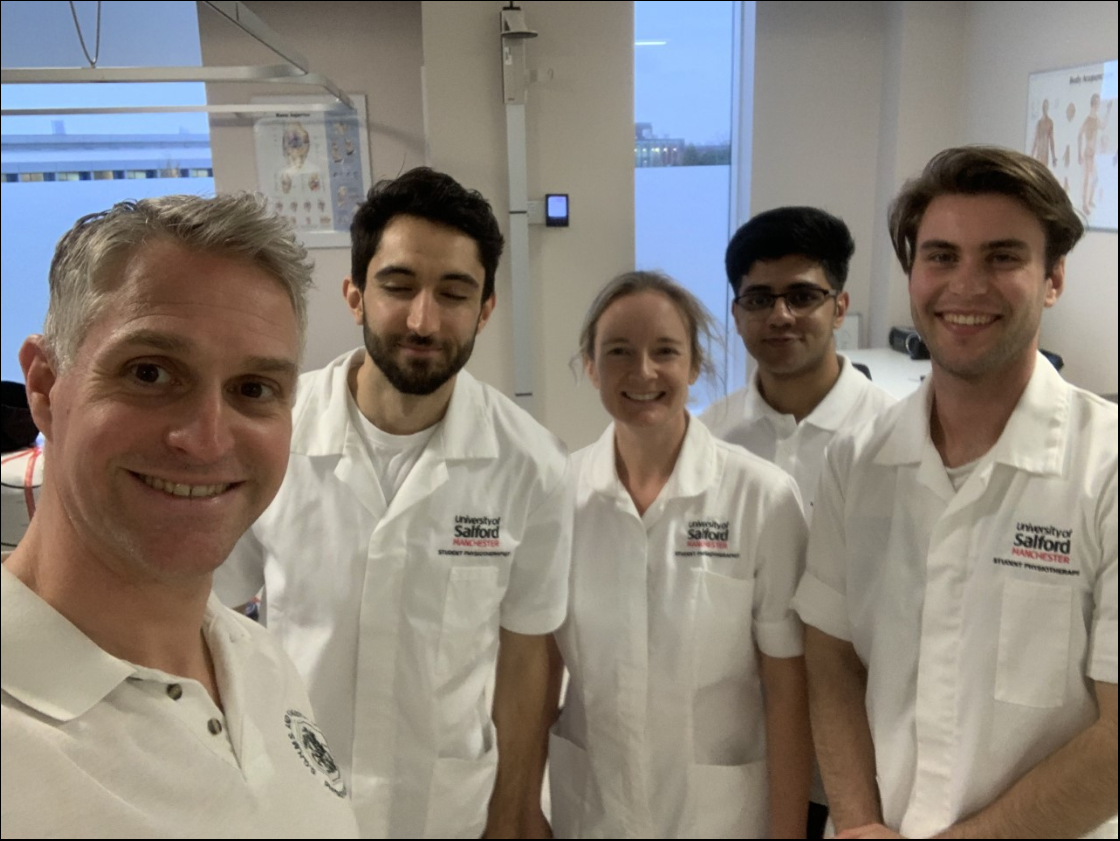
Despite only being in their first year, Students from the University of Salford are already capable of basic diagnosis, treatment and exercise prescription for real patients.

In their first year of study the cover peripheral Postural assessment, movement analysis, anatomy and physiology, electrotherapy, manual therapy, massage, and joint mobilisation.


The University of Salford Physiotherapy department now have a service that is run by students as part of their learning experience as they translate theory from the classroom into practical skills with real patients.


Students get the opportunity to work at the MIHP for 6 weeks, under the guidance of their Physio Tutors, Dale Walker and Ray Healy.

Click on the link below to book:


Friday, March 22, 2019

Sarah describe her experience at the MIHP


Click on the link below to book:


Sarah has just finished her 6 week placement at the Student-Led Physio Service run from the Manchester Institute of Health and Performance (MIHP).

This is a unique selling point for students who have volunteered their time to improve their clinical skills.

All students significantly improve their confidence, learn new treatment techniques and demonstrate their new skills on real patients at affordable prices.


The University of Salford Physiotherapy department now have a service that is run by students as part of their learning experience as they translate theory from the classroom into practical skills with real patients.


Click on the link below to book:

Tuesday, March 19, 2019

The MIHP as a Centre for Teaching Sports Medicine


Click on the link below to book:


There is always lots of teaching and sharing of knowledge happening at the MIHP.

Every Wednesday afternoon Physio Students from the University of Salford provide affordable Physiotherapy for the Manchester Community by running our Student-Led Physio Service at the Manchester Institute of Health and Performance (MIHP).

This week was a rare treat where I attended a conference on Tendinopathy and Bone stress delivered by an expert team incuding: 


Dr Leon Creaney

Interesting talk about using Gelatine in your diet for Tendinopathy.

Finally, a legitimate reason to eat wine gums!


Dr John Rogers

More discussion about REDS

Relative Energy Deficiency in Sports and how this can lead to the Female Triad.


and Team GB Triathlon Physio Oli Williamson

Soleus is king in distance running.

More bent knee calf raises and sled pushes for runners.

Click on the link below to book:


Monday, March 11, 2019

Elliot’s experience of the Student-Led Physio Service


The University of Salford Physiotherapy department now have a service that is run by students as part of their learning experience as they translate theory from the classroom into practical skills with real patients.

Click on the link below to book:


Elliot has just finished his 6 week Physio placement at the Manchester Institute of Health and Performance (MIHP).

Elliot states that it has been a beneficial clinical experience with real patients, learning treatment techniques including Taping and Acupuncture.

Under the guidance of their Physio Tutor, Dale Walker.


Click on the link below to book:


The Student-Led Physiotherapy Service is back for 2022

  The Student-Led Physiotherapy Service from the University of Salford is back for 2022 We are located in the Brian Blatchford Building, at ...